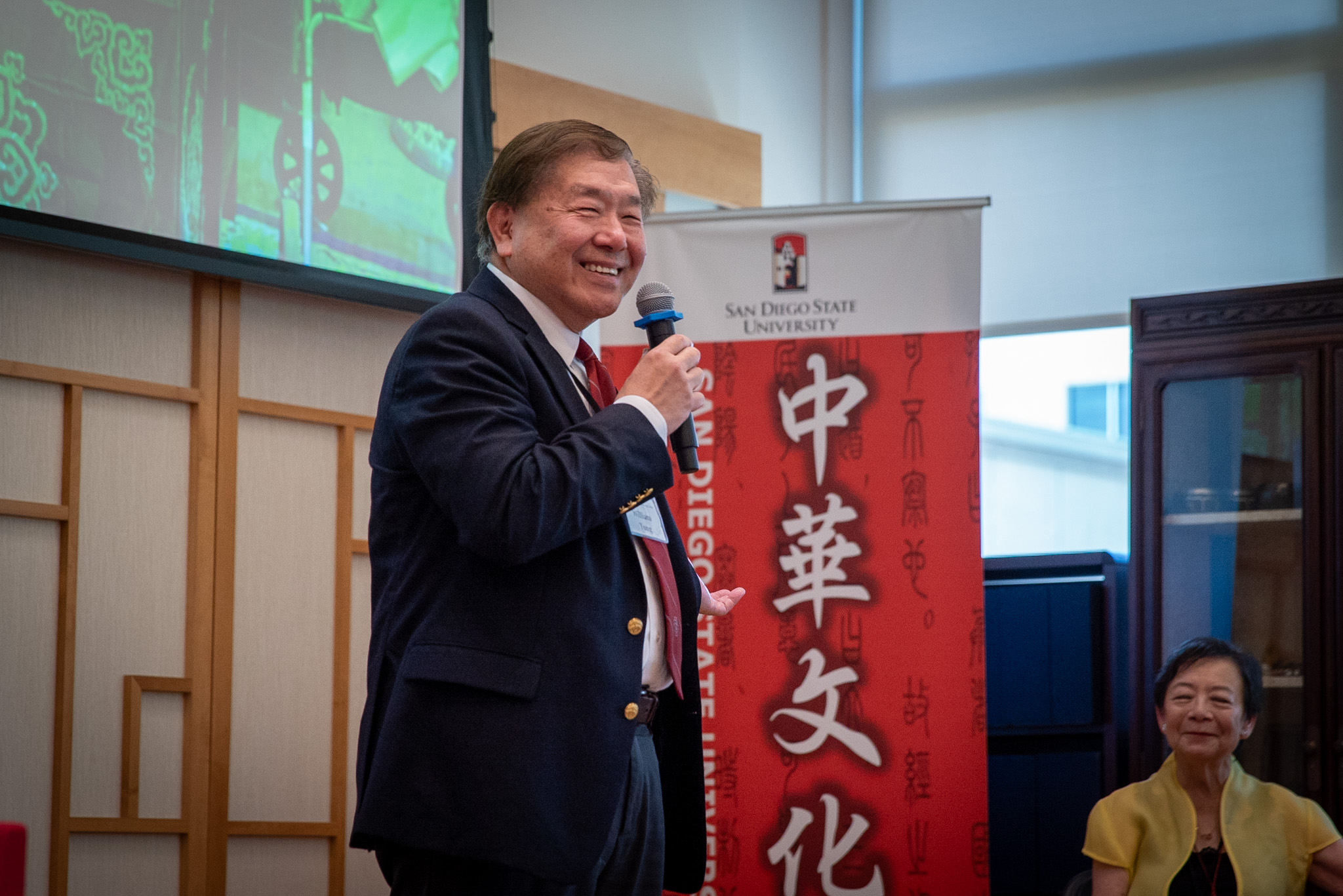
(劉麗容、董家齊)
董家齊博士自2020年起於聖地牙哥州立大學(San Diego State University, SDSU)擔任代理教務長(Interim provost)、副教務長(vice provost),於2025年正式遴選為資深副校長(Senior Vice President, 縮寫VP)一職,成為少數於美國大型州立大學擔任此一最高學術行政職務的華裔學者。
董博士於1984年畢業於愛荷華州立大學(Iowa State University),取得分析化學博士(Ph.D.)學位。1985年,在完成美國能源部橡樹嶺國家實驗室(Oak Ridge National Laboratory)的博士後研究後,加入聖地牙哥州立大學,展開其長達四十年的教學、研究與行政服務生涯。1989年晉升為副教授,並於五年後升等為教授。任教期間,他指導超過50位博士與碩士研究生(來自加州大學聖地牙哥分校與聖地牙哥州立大學),並培育來自多國的博士後研究人員及訪問學者與教授,對國際高等教育與科研人才培育貢獻卓著。
2003年,他獲美國化學學會聖地牙哥分會頒發「傑出科學家」(Distinguished Scientist)獎項;該獎歷年22位得主中,有2位後來榮獲諾貝爾化學獎,足見其學術成就之卓越。2005年,他獲授「化學與生物化學特聘教授(Distinguished Professor)」頭銜,同年並榮獲SDSU最高研究榮譽——「Albert Johnson大學研究獎」,以及Sigma Xi研究學會頒發的「傑出成就獎」。此外,他亦曾獲2008年SDSU校長領導獎、1990年、1991年與2000年傑出教師獎,以及2002年科技創新獎。2017年,他獲頒「SDSU Faculty Diversity Award」,長期致力於推動校園多元共融,積極提攜後進。即便身負繁重行政職責,至今仍持續自願擔任該校化學與生物化學特聘教授。
在研究方面,董教務長曾獲得美國國家科學基金會(NSF)、美國國立衛生研究院(NIH R01)、美國國家普通醫學研究所、美國國防部、美國國土安全部、美國陸軍研究辦公室、貝克曼基金會,以及嬌生公司、洛克希德.馬丁公司等多個機構的重要研究資助。他擁有多項非線性多光子雷射技術相關專利,並曾擔任NIH、NSF、國防部、NASA及美國化學學會等研究審查委員會委員,亦長期為國際專業期刊擔任審稿人。此外,他曾於加州拉荷亞創辦一家專門從事國防與安全專案的雷射技術公司,成功將學術研究成果轉化為實際應用。
其研究成果廣受學界與媒體關注,曾刊登於《Analytical Chemistry》、《Applied Spectroscopy》(封面報導),並登上《San Diego Union-Tribune》頭版,亦接受ABC、CBS、NBC、Fox、KUSI、KPBS、UCSD-TV與University of California-TV等多家電視媒體專訪。他也曾擔任SDSU鐘塔基金會(Campanile Foundation)董事會成員,並出任多所大學與學術機構董事,積極推動國際教育與跨國學術合作。
不平凡的童年:從難民背景到學術領導
❓. 請與我們分享你的成長背景。
我的成長背景或許有些不尋常。我的父母實際上是日本侵略中國時的難民。日本人來了之後,他們就一路往西逃難,逃離了家鄉。他們一直往西走,最後到了當時的英屬屬地緬甸。其中一個原因是,我的父母當時還很年輕,只是小孩子,而我的祖父那一代,包括父親的叔叔們那一代人,早年沿著所謂的「英國通道」建立起商業網絡,例如印度、杜拜、新加坡、香港等等。所以我的父親和他的堂兄弟們都沿著這條路線定居下來,而我的父親恰好被分配到了緬甸,我就是在這裡出生的。事實上,我的祖父是在香港去世的,當時他正從昆明到香港出差,大約在 1880 或-1890 年之間,確切年份我並不清楚。
但我記得,緬甸當時是英國的殖民地。所以我就讀的是曼德勒聖伯多祿中學(St. Peter’s High School)天主教寄宿學校,老師大多是英國人,也有一些法國人和德國的神父和修女,以及一些美國人,但主要是英國和德國的神父,這是一所相當不錯的學校。他們在緬甸有三、四所規模都很大的學校。而我從幼兒園一直到高中整整12年都是在那裡完成的。
當我完成學業後,我原本計畫前往美國深造。然而父親的過世,身為長子——即使我有年長的姊姊——我仍被要求留下來承擔家務。當時的商業往來多半建立在口頭承諾與握手之上,而非正式合約。母親告訴我,必須留下來協助處理家族的生意。其實我對經商並無興趣,一心想繼續求學,但因父親去世,我在緬甸待了大約兩三年的時間。
最終,我還是來到了美國,就讀於一所天主教底特律大學(University of Detroit。但我只在那裡待了一年多一點,就獲得了美國能源部的獎學金,前往愛荷華州立大學的艾姆斯國家實驗室(Ames Laboratory),這裡是能源部下屬的實驗室,所以我在那裡獲得博士學位。我的專業是化學,研究方向是同位素和核子相關研究。由於我的研究背景,我就繼續在田納西州的橡樹嶺國家實驗室(Oak Ridge National Laboratory)工作。這基本上算是之前工作的延續。橡樹嶺國家實驗室當時是延至至今依然是美國能源部最大的實驗室之一,擁有最多的核子材料,當時我們正在進行這些項目。
然後我決定去大學環境工作。因為橡樹嶺國家實驗室是一個戒備森嚴的實驗室,你甚至不能住在距離實驗室17英里以內的地方。你必須住在規定範圍之外,但那是40年前的事了。因此我來到了聖地牙哥州立大學,我在這裡工作的第41年。
從系主任到教務長:行政、教學與研究的平衡
❓. 但現在你其實已經不再授課了,對嗎?
是的,我非常樂愛教學,但作為教務長,工作實在非常繁忙,而且制度上也不允許。因此,我可能只能以志願性的方式參與教學。不過,在我擔任副教務長的第一年,確實曾經教過課,因為當時化學系找不到合適的人選來教授我以前所教的那門課,尤其是那個特定的課程內容。總之,我一直很希望能夠回到課堂教學。
但目前雷射實驗室裡還有博士生和本科生。並且最近獲得了一項全新的國家科學基金(NSF)補助。我仍然積極地進行研究、發表論文,而且還在繼續我的研究工作。在我離開國家實驗室之後,技術方面並沒有改變,只是現在應用領域變成了醫學,而不是能源、核能或安全領域。我們可以使用安全的同位素來追蹤人體內的疾病的醫學應用。我們可以使用其他方法來追蹤同位素,而不是使用放射性藥物,對技術人員和患者都更加安全。
❓. 請你繼續努力。那麼,你怎麼看待十年後的自己?
老實說,我也不太確定。我想十年後,我應該還是在工作——不管是做研究、寫作,或是從事某種需要思考與創造的事情。擔任教務長當然很好,但這從來不是我刻意追求的職位,只是一路走來,自然發生的結果。
事實上,我最初是被推選為系主任的。所以一路走來,我被要求做這些事情,我從來沒有主動爭取過。但我認為我已經從中有所收穫。我現在意識到我可以勝任這份工作,同時還能繼續做研究。以前我以為如果你成為行政人員,就必須放棄研究,但事實並非如此。所以你仍然還是可以找到時間繼續研究。我在我們系裡是唯一一位有色人種,這種情況持續了大約20年。
當我擔任系主任之後,開始招募了很多有色人種的教職員,並招募了聖地牙哥州立大學的第一位女性化學教授。因為如果你仔細觀察,我們化學系的大學部學生中,有一半是女生。我們需要有女性化學教授。所以現在我們的教職員團隊非常多元化。我們的教授越來越像我們的學生了。而且我從系主任到學院再到大學層級的轉換過渡並不難,從系主任到教務長的過渡相對來說比較順利。我先擔任了副教務長三年,接著擔任代理教務長兩年,並於2025年起出任教務長。
五年中雖然面臨不少挑戰,但我們擁有一支非常出色的團隊,校長也對校園發展給予高度支持。整體而言,校園的狀態從未像現在這樣好。即便挑戰依然存在,這仍是一個令人振奮的時刻。目前,我們已躋身全美前5%的一級研究型大學(R1)行列,每年收到約123,000份入學申請,競爭相當激烈。我們的申請人數甚至超過多所加州大學校區。學校聲譽持續提升,學生素質也非常優秀。現在正是學校發展的一個關鍵而美好的時機。
我們也持續在Mission Valley和Imperial Valley及中亞的喬治亞共和國進行擴展。先前我們才在Mission Valley舉行了621個住宅單位的動工典禮。緊接在Imperial Valley舉行了一棟新科學與工程大樓的剪綵典禮。這棟建築是州長特別提供的資金,總計八千萬美元,用於建設STEM大樓,以便進行鋰研究。這是SDSU Imperial Valley歷史上第一次有科學實驗室。該校區已經存在65年,但從未有科學大樓。現在他們將開設科學相關專業。我們最近也開始了護理專業,以及環境健康專業。還將開設化學學位和電機工程學位,以與鋰產業合作。能在聖地牙哥州立大學工作非常令人振奮。
社會責任的延伸 與後進指導
❓. 是的,聽起來真的非常令人興奮。你剛才已經部分回答了我們的下一個問題。你認為你的社會責任是什麼?
我一直都在指導他人,特別是年輕的、不同族裔教職員工和年輕的行政人員。因為我深知,對許多人而言,學術研究與行政領導常被視為必須二選一的道路。我一直告訴他們,其實不需要為了其中一條路而放棄另一條。我總是這樣告訴他們。如果你有興趣,也希望產生實質影響,那就勇於擔任系主任、院長,或嘗試任何你感到投入並想挑戰的角色。我自己後來才體會到,從事行政工作,其實不必放棄研究;兩者完全可以兼顧並相互促進。
❓. 這真的是個很好的建議。
是的,如果我早知道這一點,我會更早去做這些事情。我等了將近三十年,才願意答應擔任系主任。所以,這就是我給年輕人的建議。我也持續指導並與其他系主任交流,在擔任系主任時,也會指導他們該怎麼做。我甚至在全國層級舉辦講座。美國化學學會曾邀請我,為全國各地的化學系主任提供輔導與經驗分享。我告訴他們同樣的一件事:你不需要放棄你的研究。因為有很多非常優秀的人,其實可以成為非常出色的系主任或院長。
❓. 那麼,可以跟我們分享誰是你一路走來的導師呢?
有很多人影響了我,其中可以一路回溯到我小學的時候,那些天主教神父對我影響很深,他們真的非常好。我還記得求學期間二年級、三年級、七年級、九年級時的老師,都是很好的老師。後來,隨著英國撤離,當地政府將學校國有化,許多老師回到了自己的國家。那時,我也差不多完成了學業。直到今天,我仍然與其中一些人保持聯繫——有的回到德國、法國或英國。他們確實深深影響了我,也形塑並改變了我對人生的看法。當然,在研究所階段,我也遇到過非常好的導師。一路走來皆是如此,甚至直到今天,我仍然擁有許多導師。我每天都在學習,也幾乎每天都能學到新的事物。
高等教育所面臨的挑戰
❓. 我也同意這一點。那你是如何看待當前高等教育所面臨的挑戰?
不同大學所面臨的挑戰各不相同。例如,我們的一些年輕教授,研究經費被削減甚至取消。我們正努力提供協助,但顯然無法完全彌補他們的損失,因為涉及的金額往往高達數千萬美元;在某些大學,甚至可能達到數億美元。這對所有大學來說都是一大挑戰,尤其是設有醫學院、並高度依賴聯邦經費的大學醫院。雖然我們沒有那樣的情況,但仍然有相當大的問題需要解決。
我們希望部分削減的經費能夠恢復,以便更好地支持這些年輕教授。問題在於,有些年輕教授專注於特定的研究領域,不論是環境污染、潔淨能源或其他學科。如果這些計畫被被刪減,他們其實很難轉換方向,因為那正是他們多年來專注研究的領域。因此,我們正在努力幫助他們。有些人可以轉型,有些則需要時間。透過一些慈善研究資金的支持,我們或許可以有所緩衝,並期待局勢有所改變,部分研究補助能夠恢復。我們正盡我們所能地幫助他們渡過這段極具挑戰的時期。對他們來說,這是一段非常、非常艱難的時期,涉及多個層面。
另外,州政府的預算削減也是一項多層面的挑戰。加州目前處於財政赤字狀態,這意味著州立大學的經費勢必受到影響。不過,相較於其他一些大學,聖地牙哥州立大學的情況仍算穩定,因為我們持續成長,每年都能達成招生目標。反觀加州某些大學,學生人數流失達25%,甚至 40%,情況要嚴峻得多;這些學校不僅要面對州政府的預算削減,還必須承受因招生下降所帶來的雙重財務壓力。聖地牙哥州立大學算是一所相當熱門的學校,學生都希望前來就讀。
科學之外的人文視野與歷史探索
❓. 我知道你有一些興趣嗜好。可以跟我們分享嗎?
我以前會打高爾夫,大概十幾年前常常和一些教授一起打,但因打一場球需要四、五個小時,現在我已經找不到那樣的時間了,其實我相當懷念那樣的時光。不過,我現在還是會去聽歌劇、交響樂、室內樂,各式各樣的音樂會。而且我可能跟你提過,當我還是愛荷華州立大學(位於愛荷華州艾姆斯)的學生時,我會為了看歌劇,開車來回十二個小時到芝加哥。
❓. 對,你之前曾跟我分享過,你還會飛到不同城市去看歌劇,或者開車到洛杉磯。現在還會這樣做嗎?
是的,我現在還是會。我仍然會開車去洛杉磯歌劇院。洛杉磯歌劇院比芝加哥近多了。
我的另一個興趣是歷史,我曾與中國的考古學家合作,參與絲綢之路的研究計畫,研究那些大約四千年前的木乃伊。是他們請我協助化學方面的工作,例如如何清理木乃伊、如何進行同位素定年等等。這正好符合我的研究領域,所以我就參與其中。
類似的情況也發生在義大利佛羅倫斯,和Maurizio Seracini的合作也是如此。我們研究的是畫作——雖然不是四千年的歷史,而是五百年的作品,但原理相同:使用儀器、化學分析設備,利用雷射技術來研究畫作。這些都是我非常感興趣的事情,也反映了我一直對歷史相關領域的熱忱。
❓. 說到歌劇院,你去過世界上所有著名的歌劇院嗎?
是的,大多數都去過。有些地方我剛好能看一場歌劇演出,有些則是因為當時沒有演出,就只參觀歌劇院本身。如果時間剛好對得上,我就會去排隊等候臨時票。尤其是在歐洲,你可以在演出當天排隊等票。我在維也納國家歌劇院以及其他幾個地方都做過,不過通常是站票。甚至在大都會歌劇院也是一樣。你可以去試試看買臨時票,有時候會有人退票之類,總是值得一試。所以我一直都這樣做,我通常都是臨時決定行程,沒辦法事先規劃。
❓. 我知道你也很喜歡旅行。你去過多少個國家?
就我上一次數的時候,已經超過一百個國家了。其實當數我到一百之後就不再數。我確定早就超過一百了。這也是我喜歡做的另一件事——到新的地方旅行,甚至包括南極,即使是很小的國家,比如尼泊爾、蒙古。我本來想去珠穆朗瑪峰大本營,但時間不夠,所以我們只是搭了一架小飛機,繞著珠穆瑪峰飛一圈,然後再回到原來的機場。算是一種比較「偷懶」的方式去造訪珠穆朗瑪峰。
❓. 那如果你有一整天的空閒時間,你會做什麼或讀哪一類型的書?
我其實有不少喜歡的書,尤其是歷史類的書,當然也喜歡重讀一些經典作品。有一位作家,只要他出新書,我一定會讀,那就是約翰・勒卡雷(John le Carré)。他最近過世了,所以他出版了最後一本書。接下來我就得再找其他作家了。此外,如果有時間的話,我也很想寫作,因為我喜歡寫作,寫作內容主要還是跟工作相關。
❓. 如果你要舉辦一場十人的晚宴——不限時代,從古到今都可以——你會邀請哪十位來參加?
這個問題很棒。有幾個其實很容易選。因為我是科學家,我會想見一些科學家,像愛因斯坦,還有我心目中的英雄——薛丁格、尼爾斯・波耳,以及那些奠定量子力學基礎的人。畢竟,那正是我研究的領域。我也很想見莎士比亞。
另外,如果可以追溯到那麼久以前,我會選一位法國化學家,名叫拉瓦錫(三百多年前的法國人)。原因很有趣。有一次,我們化學系做了一個「學術家譜」的研究,結果發現我們系裡所有教授都可以一路追溯到他。我們系大約有二十五位教授,如果沿著師承關係往回追,最後都會回到這個人身上。
當然,我也很想見林肯、作曲家朱塞佩・威爾第、華格納、貝多芬與莫札特。事實上,我最近才跟家人提到,莫札特去世時非常貧窮,甚至沒有人知道他被埋葬在什麼地方,所以找不到墓碑,只是在墓園入口放了一尊小雕像。
❓. 如果是我,我會想見秦始皇,還有看看長城。
沒錯就是秦始皇,因為他統一了這些小國家。而且,我一直對他墓下建造的東西感到非常著迷。就在……靠近兵馬俑博物館的一個小山丘,那就是他的陵墓。目前,我們無法知道裡面究竟是什麼,但我們知道裡面有很多汞。事實上,幾年前我們曾經想透過光纖方式用攝影機一探究竟,但我覺得我們不會得到政府的許可。因為,華人文化——不願意打擾陵墓,怕會帶來厄運,除非你能做到不實際觸碰,諸如使用地面穿透雷達之類的方法,而不破壞土壤。但這些方法有局限,能探測的深度有限。目前,技術上也還沒達到。只要有一天,我們能在不破壞山丘的情況下探測更深,我們就能知道裡面究竟是什麼。不過,我們目前知道有很多汞從裡面滲出來。
❓. 所以汞金屬一直在滲出?
是的,但已經過了兩千二百年了!所以汞的量已經減少。但問題是,在八十年代,他們做了一些測試,發現就在山丘頂部的汞含量,比周圍環境高得多,所以它仍然在滲出。而且有人認為,秦始皇把汞用作他在陵墓裡建造的城市中的湖泊和河流。當然,我們無法知道裡面究竟是什麼,但我們知道裡面有很多汞。
❓. 那你能不能提出一個計算方法,來估算「水銀河」需要多久才會完全蒸發?
我一直都想研究這個問題。在八○、九○年代,他們曾使用長管把探測設備打到地下,然後取出泥土來做分析。但我想現在已不被允許這樣做,因為對山體的擾動太大了,因為那座山比埃及金字塔還要大。當年人們根本不知道那是一座陵墓,只以為是一座普通的大山。直到他們發現了那些兵馬俑,而這些兵馬俑其實是在守護那座山,而且距離陵寢有兩公里遠,一路追查回去才發現「喔,這座山不簡單」。 正是如此。所以你必須——
❓. 走對方向。
沒錯,我也很想知道成吉思汗埋葬在哪裡?我去過蒙古,因為有些人認為成吉思汗埋在西夏遺址,也有人認為在靠近他故鄉的蒙古東部。至今無人知曉。事實上,曾經有人使用無人機尋找成吉思汗的陵墓。雖然目前還沒有決定性的結果。不過,他們確實發現了一些地基和古建築遺跡,但沒有任何確鑿的證據。我自己也曾走遍蒙古各地,在烏蘭巴托東邊有一座巨大的不鏽鋼成吉思汗雕像。那並不是他的陵墓,只是一座紀念雕像。蒙古人真的非常以他為榮。已經八百多年過去了,他幾乎征戰至威尼斯附近,甚至到奧地利的維也納。他們原本計畫攻打維也納,但就在那個時候,他去世了。這真的是史上最大的帝國,比亞歷山大大帝和凱撒的版圖還要廣大。
“ 如果你有興趣,也希望產生實質影響,那就勇於擔任系主任、院長,嘗試任何你感到投入
並想挑戰的角色。 ”
未來展望
❓. 非常精彩的分享,最後,請問你有什麼想補充的嗎?
我想你已經問完我所有的問題了。我其實對「指導後進」這件事非常有熱情,不只是華人或亞洲人,而是所有人。你看看我們的大學體系,在校長或教務長這一層,亞裔領導者其實非常少。在加州州立大學系統裡,只有三位亞裔教務長。以前有兩位亞裔校長,全國範圍內也只有少數幾位。像UCSB以前有一位亞裔校長,也退休了。
因此,我一直希望能鼓勵年輕一代多去服務、多承擔責任。因為華人和其他亞裔通常比較低調,不會大聲表達自己,也不常舉手爭取機會。我們需要鼓勵他們,讓他們更願意站出來,增加能見度。這也是為什麼,每次我與這群人對談時,我都會鼓勵他們……去參與志願服務,去服務他人。
儘管亞裔學者長期活躍於學術界,但真正能晉升到教務長或大學校長層級的人卻寥寥無幾,這背後有著多重原因。即使在研究型大學、實驗室或擁有大量亞裔教師的學校中,多數人仍未能進入這些領導職位。因此,董家齊博士聖地牙哥大學資深副校長的任命為年輕世代樹立了一個重要的典範,也提供了寶貴的指引。
SDSU Provost and Senior VP
Dr. William Tong 董家齊 博士
|A Life Between Science x Education, and the World
BY LILLY CHENG, WILLIAM TONG
Dr. William (Bill) Tong has served in senior academic leadership roles at San Diego State University (SDSU) since 2020, including Interim Provost and Vice Provost. In 2025, he was formally appointed Provost, becoming one of the few Chinese American scholars to hold the highest academic administrative position at a large public university in the United States.
He received his Ph.D. in Analytical Chemistry from Iowa State University in 1984. After completing his postdoctoral research at the Oak Ridge National Laboratory, U.S. Department of Energy, in 1985, he joined San Diego State University, beginning a distinguished academic career spanning four decades in teaching, research, and academic administration. He was promoted to Associate Professor in 1989 and to Professor five years later. During his tenure, he has mentored more than 50 Ph.D. and Master’s students from San Diego State University and the University of California, San Diego (UCSD).
In the area of research, he has secured major funding from a wide range of organizations, including the National Science Foundation (NSF), the National Institutes of Health (NIH R01), the National Institute of General Medical Sciences, the U.S. Department of Defense, the U.S. Department of Homeland Security, the U.S. Army Research Office, the Beckman Foundation, as well as industry partners such as Johnson & Johnson and Lockheed Martin. He holds multiple patents related to nonlinear multi-photon laser technologies and has served on NIH study sections and review panels for NSF, the Department of Energy (DOE), NASA, and the American Chemical Society. He is also a long-standing reviewer for international peer-reviewed scientific journals. In addition, he founded a laser technology company in La Jolla, California, focused on defense and security projects, successfully translating academic research into practical applications.
An Unusual Childhood
From Refugee Roots to Academic Leadership
Dr. Tong describes his upbringing as somewhat unusual. His parents were refugees during the Japanese invasion of China, fleeing west along the so-called “British corridor” and eventually settling in British-colonial Burma, where he was born. He completed twelve years of schooling—from kindergarten through high school—at St. Peter’s High School in Mandalay, a Catholic boarding school run primarily by British and German priests, with additional French and American teachers.
Although he initially planned to continue his studies in the United States, the death of his father required him, as the eldest son, to remain and assist with the family business. After two to three years, he finally came to the U.S., enrolling first at the University of Detroit, and then receiving a scholarship from the U.S. Department of Energy to pursue graduate studies at Iowa State University’s Ames Laboratory, focusing on chemistry with an emphasis on isotopes and nuclear research. Following his doctorate, he continued this work at the Oak Ridge National Laboratory in Tennessee.
Over forty years ago, he decided to transition into academia and joined San Diego State University (SDSU), where he has now served for more than 41 years.
Transitioning from Department Chair to Provost
Balancing Administration, Teaching, and Research
Transitioning from department chair to college-level administration and then to the university level was relatively smooth for Dr. Tong. He first served as Vice Provost for three years, followed by two years as Interim Provost, and then as the Provost starting in 2025.
Although he has always loved teaching, serving as Provost comes with demanding responsibilities and institutional constraints, limiting his ability to teach regularly. He may only participate in teaching on a voluntary basis. During his first year as Vice Provost, he did teach a course because the Chemistry Department could not find a suitable instructor for a specific course he had previously taught. Now, even he hopes to return to the classroom, but as Provost, the schedule is extremely busy.
Despite administrative duties, Dr. Tong remains actively engaged in research in his laser laboratory, mentoring graduate and undergraduate students. He recently secured a new NSF grant and continues to publish and maintain his projects. The techniques he developed in national laboratories remain largely unchanged, though their application has shifted from energy, nuclear, or security domains to medical applications, using safe isotopes to track diseases in humans instead of radioactive drugs—enhancing safety for both technicians and patients.
The Challenges of Being a Provost
Leadership, Stability, and Support in a Time of Change
Although Dr. Tong has faced numerous challenges during his tenure as Provost, he notes that the university benefits from an outstanding team, and the President provides strong support for campus development. Even with ongoing challenges, this remains an exciting time. SDSU is a R1 research institution, and hence, SDSU is among the top 5% of universities in the U.S., receiving approximately 123,000 applications annually—surpassing even several University of California campuses. With consistent enrollment growth, SDSU remains relatively stable, whereas some other campuses face student attrition rates as high as 25% to 40%.
Like other universities, SDSU faces challenges related to research funding. Some junior faculty have seen their grants reduced or even canceled, often involving tens of millions of dollars. Dr. Tong notes that the university is actively providing support. Some research projects are highly specialized—whether in environmental pollution, clean energy, or other fields—and these faculty members have focused on these areas for years, making it difficult to pivot. The university is making every effort to help them navigate this challenging period, including providing support through philanthropic funding.
“ I never actively sought to become a provost—it just happened. In fact, I was initially drafted to be a department chair. Along the way, I was asked to take on additional responsibilities, but I never pursued them on my own. I’ve learned that it’s okay, because now I realize that I can do this and still conduct research. I used to think that if you become an administrator, you have to give up your research, but that’s not the case. You can still find time to do research. ”
Expanding SDSU’s Footprint
Mission Valley, Imperial Valley and Georgia Expansion
The university’s reputation continues to rise, and the quality of its students remains exceptionally strong. This is a pivotal and promising moment in SDSU’s development.
SDSU is actively expanding its presence in Mission Valley and Imperial Valley, as well as in the Republic of Georgia in Central Asia. Recently, the university held a groundbreaking ceremony for 621 new residential units in Mission Valley. Shortly thereafter, SDSU Imperial Valley celebrated the grand opening of a new Sciences and Engineering Laboratory building.
The new facility was constructed with $80 million in funding specially allocated by the governor as part of the Lithium Valley initiative. It will serve as a STEM-focused center supporting lithium research. This milestone marks the first science laboratory in the 65-year history of SDSU Imperial Valley—a campus that had never previously housed a dedicated science building.
With the completion of this facility, the campus will now offer science-related academic programs. Nursing and environmental health degrees have already launched, with chemistry and electrical engineering programs forthcoming to support collaboration with the lithium industry and prepare a highly skilled workforce.
“ Everything is now in place. I believe this is an exciting time, and it's thrilling to be part of SDSU. ”
A Humanistic Perspective Beyond Science: Dr. Tong’s Exploration of History
Daily Life with Art, Literature, and Reflection
About ten to fifteen years ago, Dr. Tong often played golf with colleagues, each round taking four to five hours. Although he fondly remembers those times, his busy schedule now makes it impossible to find the time.
He continues to have a deep love for the arts, frequently attending opera, symphony, and chamber music performances. When he was a student at Iowa State University in Ames, he drove 12 hours round-trip to Chicago for years just to see operas. Today, he still drives to the Los Angeles Opera, which is much closer than Chicago. Dr. Tong also enjoys reading, particularly historical works and classic literature. John le Carré is one of his favorite authors, and he always reads each new release. Unfortunately, le Carré recently passed away, and his final book has been published. When time permits, Dr. Tong also writes, mainly on topics related to his research and professional work.
Dr. Tong is passionate about travel and has visited over one hundred countries, including Antarctica and smaller nations such as Nepal and Mongolia. He had originally planned to visit the Everest Base Camp, but due to time constraints, he ultimately took a small plane to fly around the peak.
A Vision Bridging Science and the Humanities
During the interview, he was asked a question: if he could invite ten people from any era to a gathering, who would he most like to meet? Dr. Tong did not hesitate to first mention several scientific giants, including Einstein, as well as his personal heroes—Schrödinger, Niels Bohr, and all those who laid the foundations of quantum mechanics, since this has been the field he has devoted himself to for many years.
He also specifically mentioned the 18th-century French chemist Antoine Lavoisier. The reason is very interesting: in a project tracing the “academic genealogy” of the chemistry department, it was discovered that among approximately twenty-five professors, following their mentorship lineage back, they all ultimately trace back to this French scientist from over three centuries ago.
In the realm of the humanities, Dr. Tong is equally inspired. He stated that, if given the chance, he would also like to meet Shakespeare, Abraham Lincoln, and composers Giuseppe Verdi, Wagner, Beethoven, and Mozart.
The Intersection of Science, Art, and History
Dr. Tong’s passion for history and art extends beyond reading and appreciation—it has repeatedly intersected with his scientific expertise. He participated in an international research project along the Silk Road, collaborating with Chinese archaeologists to study mummies approximately 4,000 years old. He was invited to provide his expertise in chemistry, assisting with cleaning, preservation, and isotopic dating of the mummies. This research aligned closely with his professional background, allowing him to fully engage in the work.
He also collaborated in Florence, Italy, with scholar Maurizio Seracini, studying paintings approximately 500 years old. Using laser technology and chemical analysis techniques, he applied scientific methods to the preservation and authentication of artworks. These cross-disciplinary explorations are among the work he finds most engaging and reflect his deep passion for both history and art.
Exploring Historical Culture and the Limits of Technology
Regarding historical figures in China, Dr. Tong has expressed a strong fascination with Emperor Qin Shi Huang, particularly the underground tomb beneath the hill near the Terracotta Warrior Museum. He notes that the internal structure of the tomb remains largely unknown, though scientific studies have confirmed that substantial amounts of mercury still exist within the site.
Years ago, he discussed with a research team the possibility of using fiber-optic cameras to explore the tomb’s interior. However, he understood that such a plan would very likely not receive approval from the Chinese government. In Chinese culture, disturbing a tomb is considered inauspicious unless completely non-invasive methods are employed, such as ground-penetrating radar. Even so, he acknowledges that these technologies remain limited in depth and resolution, and current scientific capabilities are insufficient to fully reveal the tomb’s interior.
Nonetheless, studies indicate that mercury continues to seep from the tomb. Although the total amount has significantly decreased over the past 2,200 years, tests conducted in the 1980s showed that mercury levels at the top of the mound were still considerably higher than in the surrounding environment. Some scholars speculate that Emperor Qin may have constructed an underground city within the tomb, using mercury to symbolize rivers and lakes.
When asked whether it would be possible to develop a calculation to estimate how long the legendary “Mercury River” might take to evaporate, Dr. Tong said this has long been a subject of fascination for him. He noted that in the 1980s and 1990s, researchers had inserted pipes underground to collect soil samples for analysis. However, this method caused excessive disturbance to the tomb, and under current heritage protection standards, such approaches are no longer permitted, greatly limiting further research.
The Unsolved Mysteries of Great Emperors
Beyond Emperor Qin Shi Huang, Dr. Tong is equally fascinated by Genghis Khan. He has personally traveled extensively throughout Mongolia, yet, like Qin Shi Huang’s tomb, the true burial site of Genghis Khan remains a mystery. Scholars speculate that his tomb may be near his summer camp or closer to his hometown in eastern Mongolia, but such information has long been classified as highly secret, with no definitive conclusions to date.
In recent years, he has recruited research teams attempting to use drones to search for the tomb. While they discovered some foundations and ancient building remnants, no conclusive evidence has been found.
Reflecting on his travels in Mongolia, he shared: “East of Ulaanbaatar stands a massive stainless steel statue of Genghis Khan. It is not his tomb, but a commemorative monument. The Mongolian people are truly proud of him. Over 800 years have passed, and his conquests extended almost to Venice and even to Vienna in Austria. They had planned to attack Vienna, but he died at that time. It was truly one of the largest empires in human history, even larger than those of Alexander the Great or Julius Caesar.”
Encouraging the Next Generation
Since assuming the role of chair of the Department of Chemistry, Dr. William Tong observed that approximately half of the department’s undergraduate students were women. This realization prompted him to actively recruit female chemistry faculty, gradually building a more diverse and inclusive academic team.
During his tenure as provost, Dr. Tong has remained deeply committed to mentoring younger colleagues, particularly early-career faculty members and administrators from diverse backgrounds. He points out that at the level of university presidents and provosts, Asian leaders remain significantly underrepresented. Within the California State University system, there are currently only three Asian provosts. While there were previously two Asian university presidents, both have since retired. Nationwide, the number of Asian leaders in such senior academic roles remains limited.
For this reason, Dr. Tong consistently encourages the younger generation—especially Asian Americans—to take on greater responsibility and engage in service. He observes that many tend to be reserved and less inclined to actively seek leadership opportunities. As a result, he often advises young scholars to participate in volunteer service as a way to increase visibility, broaden their impact, and gain leadership experience.
Drawing from his own experience, Dr. Tong emphasizes that taking on administrative responsibilities does not require abandoning research.
“ I always tell them that if they are interested and want to make a difference, they should pursue roles such as department chair, dean, or any position they feel drawn to. I have also learned that it's possible to take on these administrative responsibilities without giving up research. ”
Last, Provost William Tong emphasizes that taking on administrative responsibilities does not require giving up research; the two can coexist and even mutually reinforce each other. While Asian scholars have long been active in academia, very few reach the level of provost or university president, and there are many reasons for this. Even in research institutions, laboratories, or STEM-focused universities with many Asian faculty, most do not advance to these leadership positions. For this reason, Dr. Tong’s appointment serves as an important model and source of guidance for younger generations. Having the opportunity to conduct such an in-depth interview with him is truly invaluable.