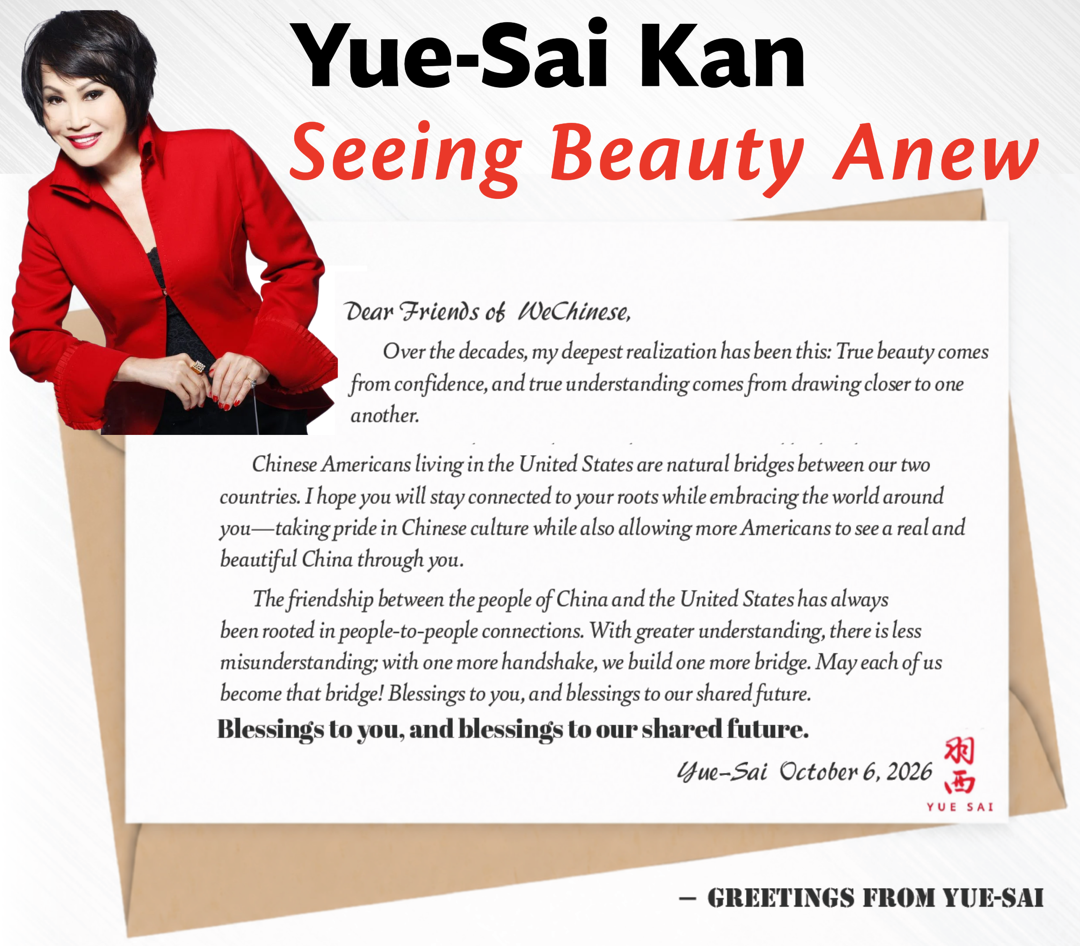
By Lilly Cheng
The first time I saw Yue-Sai Kan was on television in 1972. She was the producer and host of Looking East. Petite, radiant, and full of energy, she immediately caught my attention.
Looking East was one of the first television programs to introduce Asian cultures and traditions to American audiences. The series was widely acclaimed and received numerous awards.
For 12 years, Looking East brought Asian culture into American homes, reaching audiences across the United States through more than 700 television stations and over 1,000 channels. More than just a television program, it served as a cultural bridge between East and West, helping American audiences gain a deeper understanding of Asian cultures.
From Guilin to Hong Kong - A Journey Across Cultures
Yue Sai Kan was born in Guangxi, China, in 1947. Her name reflects her roots and her parents' hopes for her future. Her father, Yung-nian Kan (靳永年), was a Guangxi University professor and Lingnan School painter, while her mother, Huigen Li (李慧根), came from a traditional, cultured family. Art, culture, and education shaped her early life.
At age two, she moved with her parents to Hong Kong. At 16, she went to Hawaii to study music and piano at Brigham Young University–Hawaii. She performed on stage and participated in a local Narcissus Queen pageant. In 1969, she earned her bachelor's degree.
After graduation, she moved to New York and entered the international trade business, exporting Chinese products such as curtains and silk to the United States. Although the business struggled amid cultural differences, the experience revealed how little many Americans knew about China.
As cable television gained popularity, a friend introduced her to a New York television station, where she began hosting a Chinese-language program. Through interviews with Chinese immigrants and Americans from diverse backgrounds, she recognized widespread unfamiliarity with Asian cultures and persistent misconceptions about China.
She began to see television as a powerful way to bridge cultural divides. This vision inspired Looking East, the television series that marked the beginning of her lifelong commitment to fostering cultural understanding between China and the West.This realization prompted her to ask a fundamental question: If television could introduce viewers to unfamiliar worlds, why not use it to help more Americans discover and understand Asia?
That idea became the starting point for Looking East, the television series she would later create, and marked the beginning of her lifelong commitment to fostering cultural understanding and exchange between China and the West.
Looking East
In 1972, Yue-Sai Kan created and hosted Looking East, introducing Asian cultures and customs to American audiences eager to learn more about Asia. Rather than simply presenting from a studio, she took her production team into the field to film in different countries and regions.
She traveled to Sarawak, Malaysia, as well as Beijing and Shanghai, China. Through stories about food, traditional Chinese medicine, qigong, cultural traditions, and everyday life, she brought an Asia that was still unfamiliar to many Americans into their homes. She later recalled that whenever the program featured Chinese food or traditional culture, the television station's phones would ring nonstop, with viewers calling to ask questions and learn more.
These responses strengthened her belief that American audiences were growing increasingly interested in Asia, especially China. Looking East thus became the starting point of her career in cultural exchange.
The program built a bridge between East and West, helping audiences overcome unfamiliarity and misconceptions. It aired for 12 years across all 50 U.S. states, reaching 765 television stations and 1,200 channels, and was recognized as one of America's most popular television programs. Yue-Sai Kan received numerous honors from organizations including the United Nations and the U.S. Congress, among them the Lifetime Achievement Award, Outstanding Woman Award, Special Achievement Award, Goodwill Ambassador Award, Outstanding Talent Award, and International Media Exchange Award. Fortune magazine even described her as the "Marco Polo of our time."
What she did went far beyond television.
From Beijing to Washington
Bridging Cultures and Building Understanding
“This had a tremendous impact because it was the first time Americans had seen China.”
- Yue-Sai Kan
In 1984, Yue-Sai Kan was invited by PBS to provide English commentary for the live broadcast of China's 35th anniversary celebration, marking the first television collaboration between CCTV and PBS.
As a Chinese American host, she helped American audiences gain a rare glimpse of China, bridging cultural differences and fostering mutual understanding.
Bringing the World into Chinese Homes
If Looking East introduced Asia to American audiences, One World carried cultural exchange in the opposite direction.
Premiering on February 23, 1986, One World was CCTV's first television series produced and hosted by an overseas Chinese presenter, as well as its first series to secure its own advertising sponsorship. Yue-Sai spent nearly two years preparing for the project, securing sponsors, assembling a production team, coordinating filming schedules with embassies, and learning Mandarin from scratch.
Beginning in New York City, the program introduced Chinese audiences to the history, cultures, and everyday lives of people around the world. During production, Yue-Sai and her team overcame challenges involving time differences, flight delays, language barriers, and unfamiliar food. To keep costs down, she took on multiple roles as host, narrator, and producer, recording both English and Chinese versions herself. She even transformed her own apartment into a workspace for research, scriptwriting, and post-production.
The program became widely popular, reportedly attracting more than 300 million viewers each week and making Yue-Sai a household name in China. Through authentic stories about people and everyday life, she opened a window onto the world's cultural diversity for Chinese audiences.
Yue-Sai - How a Lipstick Redefined Beauty
While filming her television programs, Yue-Sai Kan noticed a lack of lipsticks suited to Asian women. In 1992, she launched her cosmetics brand, Yue-Sai, blending Asian beauty needs with Chinese cultural identity. Through beauty events and The Asian Women's Beauty Guide, she helped women learn makeup techniques and build confidence. The brand's first counter opened in Shanghai, gradually becoming part of everyday life for Chinese women.
In 1996, she partnered with Coty to establish a cosmetics manufacturing company in Shanghai. In 2004, she sold the brand to the French cosmetics giant L'Oréal, ushering in a new chapter for the business.
From television production to beauty entrepreneurship, Yue-Sai Kan has consistently sought to meet unmet needs and introduce new ideas. To her, a lipstick was more than a beauty product - it was a starting point for women to build confidence and redefine beauty.
★Yue-Sai WaWa
In 2001, Yue-Sai Kan launched the Yue-Sai WaWa doll, extending her interest in Asian beauty and cultural identity into toy design. At a time when most fashion dolls featured Western looks, she wanted Asian children to see their own features and culture reflected in their toys.
With long black hair and distinct Asian features, the doll wore outfits ranging from traditional Chinese qipao to contemporary fashions. More than a new business venture, the doll expressed Yue-Sai Kan's enduring belief that beauty has no single standard and that every culture deserves to be seen and celebrated.
★Publications
Yue-Sai Kan's early book, The Art of Charm, promoted modern etiquette and social grace. She later published Chinese Gentlemen and Chinese Ladies, which were used to train staff for the 2010 Shanghai World Expo and reissued in 2018.
She also explored lifestyle, design, and personal growth in Exquisite Spaces: 25 Top Interior Designers in the World (2009), Life Is a Competition (2013), and 99 Ways to Live a Charmed Life, sharing insights on interior design, career development, life choices, and everyday wisdom.
In 1987, PEOPLE magazine described Yue-Sai Kan as “The Most Famous Woman in China.”This recognition later inspired the title of her English-language autobiography.
★Commemorative Stamps
Yue-Sai Kan's influence extends beyond television, fashion, and cultural exchange, earning her recognition through commemorative stamps. In 2002, China issued a stamp featuring her portrait, followed by a new version in 2005 reflecting her updated hairstyle. According to reports, she was the first living American to be honored with a stamp issued by the Chinese government.
This distinction reflects not only her popularity in China, but also her lasting impact in connecting China with the world through media, fashion, and cultural exchange.
★Film and Television
Following Looking East and One World, Yue-Sai Kan continued to promote cultural exchange through film and television. She narrated the documentary China: Walls and Bridges and presented China's social and cultural landscape in Journey Through a Changing China.
In 2006, she launched Yue-Sai's World, featuring celebrity interviews and international culture, introducing audiences to people, traditions, and lifestyles around the world. In 2025, she continued sharing video content through digital platforms, extending her mission of connecting cultures and fostering cross-cultural understanding.
“My life's work has always had one purpose: to introduce Chinese culture to people around the world and help them better understand China. “
- Yue-Sai -
Yue-Sai Kan One World Foundation - Turning Influence into Action
For Yue-Sai Kan, success has never been solely about personal achievement. Over the years, she has devoted her public profile, resources, and influence to philanthropy, supporting children's health, maternal and child welfare, education, and cultural exchange.
Her Yue-Sai Kan China-America Foundation later evolved into the Yue-Sai Kan One World Foundation, continuing her commitment to cross-cultural understanding through media, cultural, and educational initiatives. Its mission reflects her belief that cultural exchange can foster mutual understanding, respect, and connection across borders.
Her philanthropic efforts have included fundraising for cleft lip and palate surgeries for children and rural school construction, as well as supporting the Shanghai Soong Ching Ling Foundation's Safe Motherhood Initiative, which promotes maternal and child health in rural China. In 2001, she was appointed a UNICEF Say Yes Ambassador, advocating for children's rights. She also contributed funds to support the Fourth World Conference on Women, held in Beijing in 1995.
Education has remained another long-standing priority. She established scholarships at several schools and universities, including Peking University, to support young students and emerging professionals. In 2018, she became Co-Chair of China Institute in America, continuing her work to strengthen cultural ties between China and the United States.
From television and beauty entrepreneurship to cultural outreach and philanthropy, Yue-Sai Kan has sought to direct resources toward those in need, create opportunities through education, and foster understanding through culture. For her, philanthropy is more than giving. It is a sustained commitment to opening doors for the next generation and helping people from different cultures see and understand one another.
China Institute in America
Carrying a Century-Old Mission into the Future
China Institute in America is one of the oldest nonprofit organizations in the United States dedicated to promoting Chinese culture and fostering cultural exchange between China and the United States.
Founded in 1926 through the joint efforts of Chinese and American educators, including Hu Shih, Guo Bingwen, John Dewey, and Paul Monroe, the Institute promotes a deeper understanding of China through education, art, culture, and business, serving as a bridge between the two countries.
Yue-Sai Kan has maintained a longstanding relationship with China Institute, serving on its board and participating in major initiatives. In 2016 and 2017, she co-chaired the Blue Cloud Awards Gala for two consecutive years. In 2018, she became Co-Chair of the Board, taking an active role in the Institute's development.
Yue-Sai has long championed Chinese designers on the international stage. Through China Institute, designers from China have had opportunities to present their work in New York and reach global audiences. Guo Pei was among the early Chinese designers to showcase her creations to American audiences through this platform. In 2016, she was also a recipient of the Blue Cloud Award at the Institute's 90th anniversary gala, in recognition of her achievements in haute couture, artistic expression, and bringing traditional Chinese aesthetics to the international stage.
For Yue-Sai, China Institute represents more than a historic cultural institution. It is a platform through which she continues to fulfill her mission.
Her work reflects a role she has embraced throughout her life. Rather than simply standing on stage to receive applause, she has often helped bring Chinese artists, designers, and cultural figures to the world, creating opportunities for Chinese culture and contemporary creativity to be seen, understood, and appreciated.
In 2026, China Institute celebrates its centennial. Looking back on its century-long history, the partnership between Yue-Sai Kan and the Institute illustrates how cultural heritage and international exchange continue to flourish through the dedication of successive generations.
Lighting the Way to the Next Century
By Pu Ying
On September 8, 2026, the Pierre Hotel in New York City glowed with light and elegance. China Institute in America, founded in 1926, held its Centennial Grand Fashion Gala there to celebrate a century of cultural exchange and achievement.
On September 8, 2026, the Pierre Hotel in New York City glowed with light and elegance. China Institute in America, founded in 1926, held its Centennial Grand Fashion Gala there to celebrate a century of cultural exchange and achievement.
That evening, I was fortunate to attend at the invitation of Ms. Yue-Sai Kan. As I sat in the audience, watching the lights come up and Chinese design and art meet international fashion on the same stage, I kept asking myself: What does a hundred years truly mean for an institution? For an individual, a century is almost a lifetime. For an organization, it represents generations of people who have protected its legacy, carried its traditions forward, and entrusted them to those who follow.
In 1926, American and Chinese educators and scholars, including John Dewey, Paul Monroe, Hu Shih, and Kuo Ping-Wen, helped establish China Institute in America. Their vision was to build a bridge between East and West through culture and education—to help Americans better understand China and to ensure that Chinese culture could be shared and sustained abroad.
To me, Chinese community organizations overseas hold another special meaning: they can become a home away from home.
They are places where someone understands the sound of your native tongue and knows where you come from. During holidays, familiar faces gather, and the flavors of home return. When difficulties arise, there may be a helping hand ready to reach out. Gradually, strangers become friends, a community becomes a family, and a culture takes root in a foreign land.
China Institute in America has built its hundred-year history in much the same way, one step at a time.
Yet a century of history does not mean simply preserving the past. Tradition is our root, but it should never become a constraint. Culture must be passed on, but it must also continue to evolve if it is to remain meaningful and move confidently into the future. This was what moved me most about that evening's gala.
Since becoming involved with China Institute in 2016 and serving as its Co-Chair, Ms. Kan and her team have brought more than changes in the format of its events. They have helped bring about a shift in perspective: a century-old cultural institution can cherish its history while finding a contemporary language through which to reconnect with the world.
That evening, Chinese culture, Chinese design, and contemporary international fashion shared the same stage. Chinese elements were no longer simply objects to be observed or explained. They appeared with greater confidence and a distinctly modern spirit, ready to engage the world on their own terms.
Throughout her life, Ms. Kan seems to have pursued one enduring mission: building connections.
In 1978, she created Looking East in the United States, introducing American audiences to Asian cultures. In 1986, she produced and hosted One World, bringing the wider world to Chinese viewers. She later founded the Yue-Sai cosmetics brand and devoted herself to cultural exchange and philanthropy.
From television to beauty, from cultural diplomacy to charitable work, her endeavors may appear diverse, but a common thread runs through them all: helping the world understand China, and helping China understand the world.
That evening, I stood in the audience and watched Ms. Kan, approaching eighty, moving tirelessly between the stage and backstage. The lights illuminated the magnificent gowns, but they also fell upon her busy figure as she attended to one detail after another.
Suddenly, I realized that a true guide for an organization is not someone who expects everyone to follow forever. Rather, it is someone who sees the horizon first, then lights a lamp so that others can find their own way. It is not about proving one's own importance, but about breathing new life into an institution—and ensuring that, even after one has moved on, those who follow can continue along the path illuminated by that light.
In my heart, Ms. Kan is such a person: someone who lights the way.
Yet a small incident backstage that evening gave me another understanding of what it means to light the way.
I met a model from Singapore. She was exceptionally tall and wore a beautiful evening gown. I very much wanted to take a photograph with her. As we prepared to pose, she noticed the difference in our heights and instinctively bent her knees, lowering herself to accommodate me.
It was a gesture that lasted only a few seconds, yet it warmed my heart immediately.
I gently stopped her and said, “Please stand up. Your beauty is exactly what I want to capture.”
She stood upright again, and the difference in our heights remained just as striking. But at that moment, we held both our hands tightly together.
Later, I kept thinking about that encounter. The beauty that had moved me was no longer simply her height or her elegant gown.
Here was someone so tall and radiant, yet willing to lower herself ever so slightly for the person beside her. Bending down for someone else does not make a person smaller. On the contrary, it makes that person stand taller in another's heart.
That kindness, in itself, is a form of beauty.
The encounter also made me reflect on the world we live in today. Technology continues to advance, life grows more comfortable, and people seem closer to one another than ever. Yet perhaps what remains most precious is something far more fundamental: the simple kindness, compassion, and understanding we offer one another.
The centennial celebration would eventually come to an end. The magnificent gowns would be put away, the music would stop, and the brilliant lights of the hotel would go dark.
But one light must never go out.
Within that light live the culture entrusted to us by those who came before, the homesickness and perseverance of generations of overseas Chinese, and the responsibility we bear today for the future.
A hundred years ago, someone lit a lamp.
A hundred years later, someone adds another light.
People like Ms. Kan, who draw upon their wisdom, vision, love, and creativity to help a century-old institution find new directions, are the ones who light the way. And the young model who instinctively bent down for someone else backstage also illuminated a small lamp, without even realizing it.
For true light does not always come from grand achievements or extraordinary endeavors. Sometimes, it shines through a handshake, a glance, or a simple act of bending down. It appears when people who possess their own radiance remain willing to care for those around them.
A century is a trust passed from one generation to the next.
May we always remember where we came from and understand where we are going. And no matter how far we travel or how high we rise, may we never lose the kindness and compassion within our hearts.
My gratitude goes to those who planted the seeds and lit the first lamps a hundred years ago, and to all those today who continue to guard that light and add to its glow.
Because in the end, it is the light within the human heart that will illuminate the next century.
May the flame of this century continue to burn, illuminating the path behind us and lighting the way to the next hundred years.
Yue-Sai Kan and Pu Ying
Two Remarkable Women, Two Inspiring Mentors
In Cleveland, Pu Ying is a woman I deeply admire. I affectionately call her "Dandelion" because, like a dandelion, she possesses vitality and resilience, moving forward no matter which way the wind blows.
From their first meeting to a deeper understanding of one another, Pu Ying and Yue-Sai Kan have developed a bond of mutual admiration. Both believe that women should support one another, speak up for women, and share their stories with the world.
Both women are charismatic, articulate, and exceptional storytellers. Through their words and life experiences, they bring individual stories, family histories, and the experiences of entire communities to a wider audience.
For years, Pu Ying has worked tirelessly to make The Erie Chinese Journal a vibrant and respected publication. Despite countless challenges, she perseveres, determined to keep the newspaper going. Beyond publishing, she actively participates in charitable initiatives and collaborates with mainstream society to promote a positive image of the Chinese American community.
What makes her dedication even more remarkable is that she still delivers newspapers in person. Her enduring passion for journalism and the professional spirit passed down through generations of newspaper publishers are increasingly rare today. For Pu Ying, publishing is more than a job. It is a responsibility, a mission, and a commitment to her community.
Through Pu Ying's reporting, we also see Yue-Sai's longstanding dedication to philanthropy, her concern for Chinese families, and her efforts to share Chinese stories. Through mass media, these women have helped more people recognize the Chinese community's contributions and achievements while deepening their understanding of Chinese culture.
Another wonderful quality they share is their willingness to share life's beautiful and joyful moments with others. Through years of quiet dedication, they have become role models, offering strength and encouragement to countless people, often without realizing it.
In Greek mythology, Mentor represents wisdom, guidance, and companionship. Today, I would like to say that Pu Ying and Yue-Sai are our mentors.
Through their achievements and quieter acts of kindness, they have become role models and guides for generations of Chinese women. They remind us that life can be meaningful, education matters, knowledge is worth pursuing throughout our lives, and happiness grows when shared.
They give generously, work tirelessly, strive for progress, and never stop growing. Women like them deserve to be understood, appreciated, and thoughtfully documented. Their stories deserve to be told.
What gives them the strength to keep moving forward? What sustains their motivation over the years? And what enables them to discover life's deeper meaning along their journeys?
Perhaps each person would offer a different answer.
One thing, however, is certain: their lives teach us that true influence does not necessarily come from applause or the spotlight. It comes from years of perseverance, sincere generosity, and a heart willing to light a lamp for someone else.
Yue-Sai has traveled extensively around the world, gaining a profound understanding of people from diverse cultural backgrounds. Over the years, she has made outstanding contributions to cultural exchange between China and the West. Her television programs reflect her deep appreciation for culture, art, and history through the ideas behind her work. Watching her programs and reflecting on her stories opens up an endless world of possibilities and perspectives.
Yue-Sai embraces life, cherishes the present, and strives to make every moment count. She is a role model for women. Yet behind her radiance lie tremendous courage and perseverance, along with hardships and heartaches others may never fully see. The price successful women pay to achieve their dreams is often difficult to imagine, let alone put into words.
I deeply admire her and offer my heartfelt blessings. May she continue to reinvent herself, embrace new possibilities, and stride confidently toward the future.
We extend our heartfelt wishes to both Pu Ying and Yue-Sai, grateful for the stories, wisdom, and strength they have shared. May they continue to write their stories through their lives while helping more women's stories be seen, heard, and remembered.
Yue-Sai has never held public office, yet she has used television, cosmetics, and children's toys as powerful instruments for peace. Through these avenues, she has connected people, bridged cultural divides, and encouraged mutual understanding.
She embodies the spirit of living authentically and making the most of life. Through her talents, she has transformed challenges into strength and embraced culture as a mission. May she continue to create, inspire, and compose new chapters in our world's ongoing story.
Pu Ying and Yue-Sai remind us that a meaningful life is measured not solely by personal accomplishments, but also by the lives we touch, the opportunities we create for others, and the light we leave behind.
Their stories testify to the power of perseverance, compassion, and cultural understanding. May their light continue to shine, inspiring future generations of women to find their voices, pursue their dreams, and illuminate the paths of others.
【Co-Editors' Note】
I believe that when people meet at the right time, a special bond forms—one rooted in love, admiration, and understanding.
Yue-Sai Kan and Lilly Cheng, two remarkable women I call my older sisters, have always been my role models. Through their different journeys in media, beauty, and healthcare, they have shown me how love inspires us to give, serve, and bring joy to others.
When I began publishing, I knew little about the work. Twenty-five years later, my passion remains strong. The remarkable people I have met along the way have enriched my life and given me the courage to keep going.
Standing alongside these two women I deeply admire is a precious memory, reminding me of the inspiration and strength I have gained from their stories. (Ying Pu)