BY LILLY CHENG, HUIHAN LIE
Renowned entrepreneur Warren Buffett always emphasizes that curiosity is an extremely important trait.
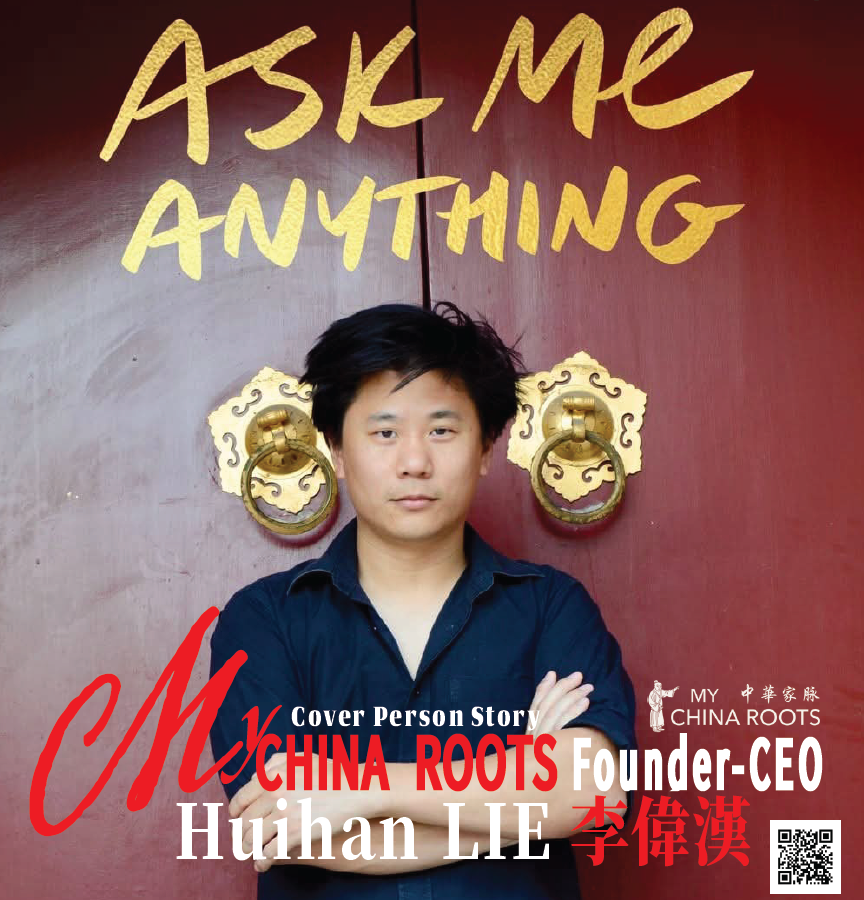
The cover figure of this issue, Huihan Lie, is someone whose life path has been guided by a strong sense of curiosity. It was this curiosity that first led him on a journey to trace his roots.
Huihan Lie was born in the Netherlands and is a seventh-generation overseas Chinese; his parents immigrated to the Netherlands from Indonesia. Growing up in the European environment of the Netherlands, he was deeply curious about his Chinese heritage.
Later, he had the opportunity to travel to China. This experience not only satisfied his long-standing curiosity, but also transformed “root-seeking” from a personal interest into a mission of helping others trace their ancestry. What began as curiosity evolved into a lifelong passion, leading him down a path that is both challenging and profoundly meaningful.
In 2012, he officially founded My China Roots, dedicated to helping people of Chinese descent around the world rediscover their family roots and reconnect with their history.
From its founding in 2012 to 2026, over the course of fourteen years, the team led by Huihan Lie has continued to grow, with members spread across the globe. Although they come from different countries and cultural backgrounds, they share a common passion—to serve Chinese communities around the world by helping them trace their family roots and, whenever possible, embark on their own personal journeys of rediscovery.
Our story begins with a young boy in the Dutch countryside, perched on his grandfather's knee in awe.
A young boy named Huihan Lie sat on his grandfather's lap, completely captivated as he listened to his stories. The family’s wealth, built on sugar plantations in Indonesia, had astonishingly been squandered through horse gambling… and even opium had once been hidden inside the pillars of their home…!
|In the beginning...
“I was born in the Dutch countryside. My parents were born in Indonesia and immigrated to the Netherlands when they were young. Aside from my name, the longevity noodles I ate on my birthday, and my appearance, there was almost nothing Chinese in my upbringing.
I knew that I was 'Chinese,' but that identity held no real meaning for me. No one in my family spoke Chinese, and I didn't know any Chinese people.”
|Why?
As Huihan Lie grew older, questions began to surface in his mind: "If all our memories are rooted in Indonesia, why do I have a Chinese face? Who were my Chinese ancestors, and what drove them to leave their homeland? With my mixed heritage, what does it truly mean to be Chinese?"
Several years later, while busy with his career, he found himself reflecting further: "Where exactly in China did my family come from? Why did they leave? And how is the China I know today different from the China of my ancestors?”
|In search of answers...
To resolve these questions, he moved to China in 2004. While working, he learned Chinese, hoping to gain a deeper, first-hand understanding of the country. At the same time, he continued tracing his family history, guided by a clue on his great-grandfather's tombstone in Indonesia, which mentioned a place called Zhushan.
A major turning point came in 2008, when his mother invited him to visit a distant relative in Xiamen. This encounter revealed one of his ancestral hometowns. Captivated by the opportunities and development in the region, he decided to stay, embarking on a journey to explore his family, history, and identity.
In July 2025, we finally met online—he was in Paris, while I was in San Diego.
Although our conversation lasted only an hour, it left us wanting more. Centered around the theme of "root-seeking," we engaged in a deep and engaging exchange.
❓.Can you share the most impressive moment from your childhood and how it shaped who you are today?
When I was around six, I was on a schoolyard in the Dutch countryside, and a little Caucasian girl stood opposite me. She pulled the corners of her eyes sideways and asked, “How can you see like that??” That moment made me feel very different and quite alone.
Around the same age, my mom gave me some advice that stuck with me: she said that if any kid ever made derogatory remarks about me being Chinese, I could tell them that while their ancestors were still walking around in bear skins, ours could already read and write. That made me realize that being different doesn’t mean being “less.”
As a teenager, I had mixed feelings about going to China. I was curious, but also afraid because even in Amsterdam’s Chinatown, I felt embarrassed that I couldn’t speak Chinese well. Eventually, I spoke with a Caucasian friend who had just visited China. I told him I was jealous in a lighthearted way, and he asked, “Why don’t you just go?” I couldn’t give him a good reason not to, and that simple question convinced me that I should just go.
❓.Tell us about your grandparents and family, and how they have influenced your values and life.
My grandfather gave me the stories and a drawing of (the start of) our family tree; my mother gave me the confidence to go out and explore the world, knowing that she’d always be there for me if something would go wrong, my father gave me the curiosity and the desire to actually go out and explore.
❓. What did you study as your major, and why did you choose this field? How did your path evolve afterward?
I studied law, specializing in international law and international relations. To be honest, I chose law because I didn’t exactly know what kind of job I wanted afterwards, and law seemed to keep many options open. I then chose international law because it was more open-ended, less fixed, and less hierarchical than (any) national law, and because the world outside the Netherlands and Europe appealed to me. My stay at the Legal Affairs Section of UNHCR taught me that I liked the international work environment, but I didn’t want to practice law. My stay at the European Commission in Beijing taught me I loved the economic & socio-political developments that China was going through in those years (2004) but also that I didn’t want to remain in the “international civil service ivory tower”. My work in consulting in Beijing then made me appreciate the intellectual challenge, but I got bored with working only at the strategic level of business operations, and working only on projects, without seeing how strategic recommendations we gave would actually be executed. I then moved in-house to the wind energy firm, where I loved China-India relations and I loved working on a cause that mattered to me (social impact), but I also wanted to build something myself, something new, and something that I felt passionate about. That was the birth of My China Roots.
❓. How would you define yourself? What three words best describe you?
Curious, people-person, determined.
❓ What motivates or drives you to pursue your goals?
Having a positive impact. Building a team where the end contribution is more than the sum of our parts. Designing a product that actually matters. Bringing families together and making people feel more connected with themselves.
❓ Where do you see yourself in the next 10 years?
In general, with all the technological and geopolitical turbulence of the world today, I cannot even see 2-3 years ahead, and think it would almost be unwise to try and have fixed plans for the coming years. The key is to stay flexible and adaptable, and to double down on the value of human connections and social interactions (while incorporating the benefits of technology and AI in those specific areas where they add value). This approach applies to my business, to the way we raise our children, and to my relations with my parents, wider family and friends.
❓. At the “ My China Roots”, was there a particular moment or event that left a deep impression on you? Why?
To be honest, every project and family is unique, and there are so many beautiful stories of reconnecting people with their families, of people getting to finally understand certain behaviors or actions of their own (grand)parents, of people feeling more at ease with their own backgrounds, and of connecting relatives in China and the US who never knew each other and truly building bridges for the future.
❓. What has been the greatest challenge you've faced at the “My China Roots”? How did you deal with it?
Building the internal bridge within our team, between an academic, historical research mindset and a technological, experimental, growth-focused mindset.
Building bridges between China and the US at this point in time. Building a company that does work where a lot of people feel that it should be non-commercial / charity-based.
Building trust with elderly guardians of valuable historical records at cultural institutions such as Clan Associations.
Raising investment from investors who are generally very traditional and hard to get to think outside of the box.
❓. What are you currently working on?
With MCR, I want to focus more on the capturing of living memories, especially of elderly people.
❓. Do you have suggestions for people who want to trace their roots?
Talk to your family members, engage with different generations, contact MCR!!!