


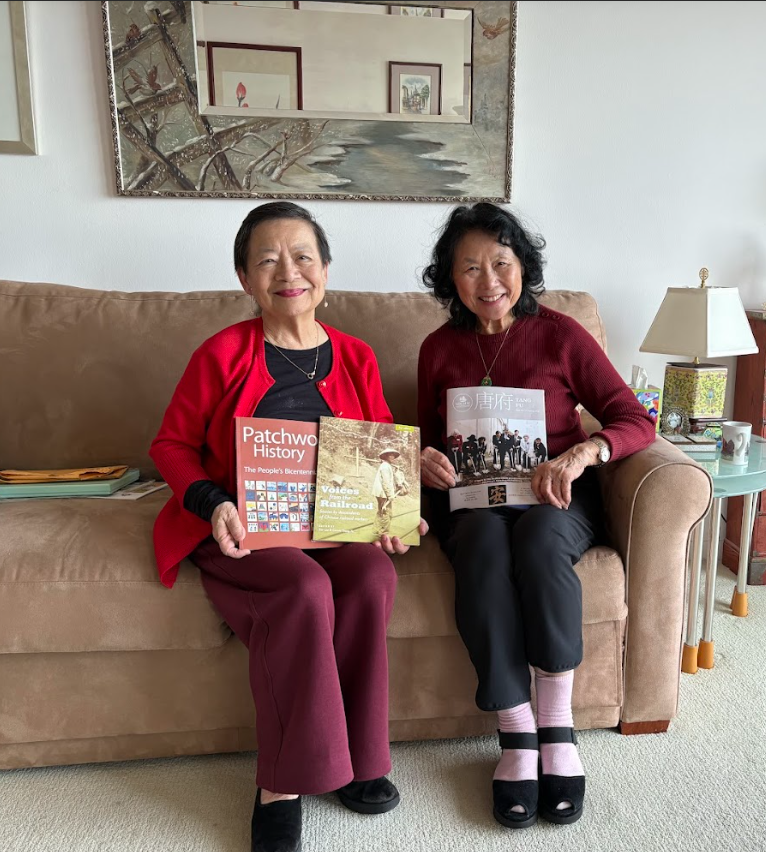
Connie Young Yu 虞容儀芳 The Keeper of Memory and the Rewriting of Chinese American History: Reclaiming Voices Together
BY Lilly Cheng
"That's our first foothold in America, but there were challenges and barriers every step of the way."
- Connie Young Yu
On a sunny afternoon before the arrival of the Lunar New Year I took a city bus from San Francisco Chinatown and stopped right in front of a fabulous condominium building next to Ghirardelli Square. I met Connie Young Yu at her pied a terre - a studio apartment with an expansive view of San Francisco Bay and Alcatraz looking up-close. Chatting and sipping tea, I felt I was stepping into a living archive of Chinese American history—one animated not just by dates and facts, but by personal life stories, memory, persistence, and moral clarity. Connie smiled and gazed into distance and talked about her first ancestor in America, her maternal great-grandfather, Lee Wong Sang, coming to America to work on the Transcontinental Railroad, and how he became a merchant in San Francisco's Chinatown, raising a family above a store on Dupont Street, today's Grant Ave.
Connie was born in Los Angeles, June 19, 1941, the second daughter of John and Mary Young, both American-born Chinese. Her early years were in Whittier, in Southern California, with her mother, sister Janey and her paternal grandparents who spoke only Cantonese to her. Her father, an engineer in the US Army Reserves, was sent overseas after Japan's attack on Pearl Harbor, assigned as a combat ordnance officer in CBI (China-Burma-India theatre of operations). After the war, he returned home to civilian life, and became a manufacturer of soy sauce, relocating his family to San Francisco Chinatown. They were able to move to a home in Richmond district, a whites only neighborhood because John's fellow army reserve officer, a German-American, bought the house first, and then sold it to him. John C. Young became a leader of Chinatown's Chamber of Commerce, organizing the first public lunar new year parade. As commander of American Legion Cathay post, he spearheaded the project to build the War Memorial in St. Mary's Square, honoring Chinese servicemen in WWI and WW2 who made the ultimate sacrifice. John and Mary Young were early supporters of the Chinese Historical Society of America (CHSA), dedicated to bringing forth the history and contributions of Chinese pioneers. It was inescapable. Connie grew up with a sense of pride—and purpose.
She attended San Francisco public schools and Mills College, graduating with a degree in English. Her senior thesis was, "Mark Twain and the Chinese."
Connie spoke with quiet authority about Chinese American history, especially the long-overlooked lives of the Chinese railroad workers who helped build the Transcontinental Railroad. She also spoke of how her parents attended the 100th anniversary of the Golden Spike, along with CHSA president Phil Choy, who was denied the opportunity to present a plaque honoring Chinese railroad workers, even though he had been invited to do so. Fifty years later, Connie would become the representative of CHSA, giving the opening address at Spike 150 on May 10, 2019, at Promontory, Utah.
She also talked about her mother and how her mother encouraged her to "do something for women." Chinese women like her grandmothers were often unseen figures who held Chinese American families together across generations of exclusion, migration, and adaptation. Their stories added another layer of depth to her work, reminding me that while railroad labor and immigration policy toward Chinese - focused on men, survival itself was sustained by women.
One of the most moving parts of our conversation was when Connie spoke about her paternal grandfather, Young Soong Quong, a loyal supporter of Dr. Sun Yat-sen who instilled the great leader's ideals in his family and community, a dedication that carried forward through future generations. "The great leader was from Heungsan district of southern China, the same as Grandpa." Heungsan was later renamed Zhongshan in honor of Dr. Sun, her father told her. He also said that their family name, Young, shared the same Chinese character as another Cantonese hero, Yung Wing, the first Chinese to graduate from an American university, who advocated the modernization of China through building railroads.
While Connie was in high school, both her mother and father encouraged her to record stories of Chinese American history from people who had lived through it. Her mother took her to interview people in Chinatown who had fled the San Francisco earthquake, as well as the editor of the Young China newspaper who had known Sun Yat-sen. Her father took her to visit an “old revolutionist,” a friend of her grandfather, who told her that in 1914 on Grant Avenue he had assassinated an envoy of Yuan Shikai, the enemy of Dr. Sun Yat-sen.
Living for decades in the South Bay, even before it was Silicon Valley, Connie has been a key figure in recovering the history of the Asian communities. She was a consultant at three archaeology sites of Chinatowns in San Jose. She was a founder of AACI, Asian Americans for Community Involvement, and is a trustee of Hakone Foundation in Saratoga. She conducted oral histories of descendants for Stanford's Chinese Railroad Workers in North America Project. She is a historian for the Chinese Historical and Cultural Project (CHCP).
Time seemed to stop at the moment when Connie spoke about Angel Island, the history of the immigration station deeply personal. Her grandmother, the widow of Lee Yoke Suey, returning from China to San Francisco, was detained in the barracks for 15 months before she was finally released by the 9th Circuit Court of Appeals. "The Chinese were presumed guilty until proven innocent."
I could almost see the hundreds of Chinese from Canton sailing for weeks and months across the ocean and finally landing on the shores of Gum San (Golden Mountain). They stepped off the ship and onto Angel Island, their eyes wide open and their hearts pounding with fear and uncertainty. Connie spoke at length about how she served on the citizens' committee that saved the immigration barracks from demolition and helped restore them as a historic monument. It is the "writing on the wall"—the hundreds of poems carved by detainees—that stand as testimony to the Chinese immigration experience.
Connie described her husband, Dr. John Kou-Ping Yu, an oncologist, as a steady source of support and intellectual companionship—allowing her to pursue all her endeavors and projects, without pay. Married for 63 years, their partnership reflects a shared belief in truth, education, and community responsibility. Connie and John have lived in Los Altos Hills since 1970, raising three children—Jennifer, Jessica, and Martin—who grew up surrounded by history, attending marches, visiting Angel Island, and participating in Chinatown events with their grandparents.
Connie spoke about her daughter, Jessica Yu, director of documentaries, TV series, and feature films, who won an Oscar for the short documentary Breathing Lessons: The Life and Work of Mark O'Brien, and that her very first film was Homebase: A Chinatown Called Heinlenville for the Chinese Historical and Cultural Project. Connie also spoke fondly of her son-in-law, Mark Salzman, author of the book Silk and Iron, describing his experience teaching in China and calling him the true Chinese scholar in the family.
Now Connie's grandchildren are carrying on the family tradition of oral history. Jessica and Mark's daughters Ava and Esme—and Clementine, daughter of Jennifer and Sean—all three have interviewed their "Poh-Poh" at length and created artworks based on their ancestral stories.
Time flew by so quickly when the evening lights descended on us. We continued our conversation over dinner at the fabulous McCormick & Kuleto's Seafood. We were savoring the delicious calamari and crab and lobster dip and chatting away. The night was young and the dialogues were fun. We walked back to her condo under the moonlight. I bid her farewell and I promised that we would meet again soon.
Meeting Connie Young Yu left me with a profound appreciation for how personal history and public history can reinforce one another. Through the strength of her family and her unwavering dedication, she has helped ensure that Chinese American stories—men’s and women’s, past and present—are remembered, honored, and carried forward. Our meeting left me with a deep sense of gratitude and responsibility. Connie Young Yu embodies what it means to be a steward of history: careful, principled, and unwavering. In preserving the stories of those who were deliberately forgotten, she has given all of us a clearer, more honest understanding of where we come from—and a better sense of what justice in historical memory can look like.