


The Chinese Architect of the Grand Egyptian Museum Shih-Fu Peng 彭士佛
By Lilly Cheng
" The museum can be nowhere else but here. Should the Pyramids disappear, the museum becomes incomplete. "
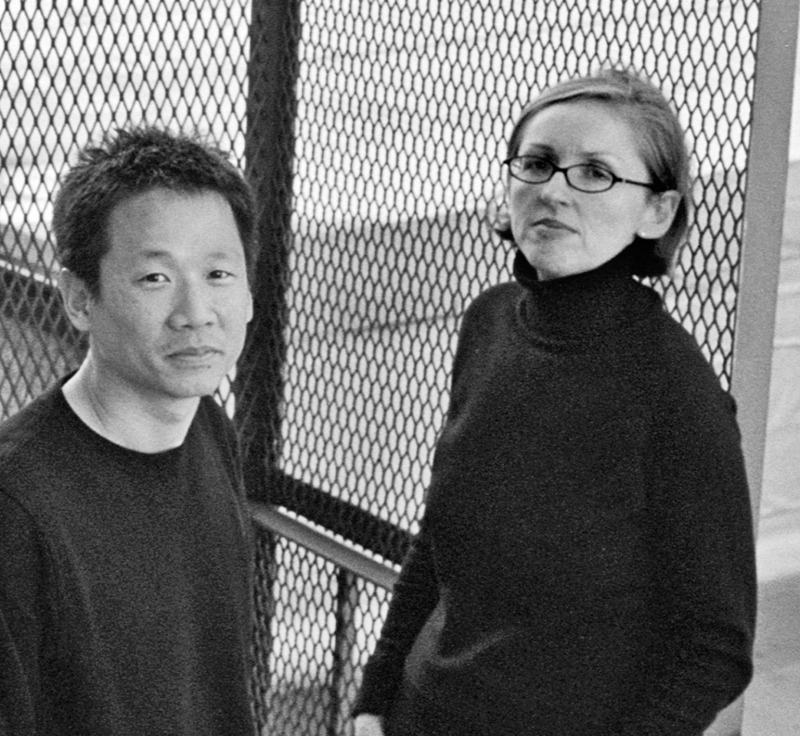
Egypt is one of the world's oldest civilizations, and the Pyramids remain one of humanity's most iconic symbols. In 2025, the Grand Egyptian Museum (GEM) near the Pyramids of Giza officially opened, presenting Egypt's thousands of years of cultural heritage. The museum was designed by Chinese-born architect Shih-Fu Peng, his wife Róisín Heneghan, and one of their students, Edel Tobin.
Peng received his Master of Architecture degree from Harvard University in 1992, where he met Heneghan. After working in New York, they founded heneghan.peng.architects in 1999 and later moved their firm to Dublin.
In 2002, their team entered Egypt's international design competition for the museum. Their anonymous proposal was selected from more than 1,500 entries worldwide. Their design was guided by a powerful concept: “The Pyramids are Egypt's gift to the world.” They envisioned a museum that would not only preserve Egypt's ancient civilization but also create a dialogue with the Pyramids, connecting the past and the present.
Unlike traditional competitions, the architects' identities were revealed only after the winning concept was selected. Their success came from the depth of their vision, leading to a landmark project completed after more than two decades of planning and construction.
On February 28, 2026, Shih-Fu Peng gave a presentation to Phi Lambda US. It was his first time speaking to an audience outside the architecture profession.
In his introduction, his nephew-in-law John Liu shared a defining moment in Peng's remarkable career.
Excerpted from John Liu’s introduction:
"… One day in 2003, Shih-Fu received a letter from overseas and announced to Róisín that they had finally won a competition. When asked 'Which one?' he replied, 'The Grand Egyptian Museum,' one which would be the largest museum in the world for a single civilization, dedicated to Ancient Egypt and its culture, society, and artifacts. Incredibly, the fledging and then totally unknown heneghan peng architects had beaten 1,556 other entries from 82 countries for one of the architectural world’s most prestigious and coveted assignments. When I heard the news, I remember saying to myself, 'Shih-Fu and Róisín just took a road trip in their quirky and somewhat unreliable Saab 9-3 sport sedan and won the 24 Hours at Le Mans!.'"
On July 18, 2026, the Cheng TCAE&B Online Seminar, organized by the Chinese Cultural Center at San Diego State University, featured Shih-Fu Peng, co-founder of Heneghan Peng Architects, as the keynote speaker. Peng personally shared the inspiration, vision, and design journey behind the Grand Egyptian Museum (GEM), explaining the ideas and philosophy that guided him and his team throughout the project.
The seminar also featured San Diego architect Mr. Joseph O. Wong as the guest co-host, who conducted an in-depth interview with Peng, exploring the museum's architectural concepts, design challenges, and the ways in which the project bridges contemporary architecture with the heritage of ancient Egyptian civilization.
About Grand Egyptian Museum
The Pyramids, Desert Landscape, and Site Topography
Shih-Fu Peng explained: “We did not visit the site in Stage 1. In Stage 2, we visited the site. We realized then that only the Pyramids can stand tall on the plateau and nothing else. We pushed our museum room down so that its coplanar with the Desert Plateau. The Pyramids stand as solitaires."
The First Guiding Idea That Shaped His Proposal
Egypt begins with its landscape. The Nile carved through the desert, creating the Nile Valley and the Desert Plateau, separated by more than 60 meters in elevation. This landscape is both geological and symbolic. The Nile Valley represents life, with its intense green vegetation expressing vitality, while the Desert Plateau represents death, where the tombs of the Pyramids stand. This contrast between life and death, between the fertile valley and the desert, became the starting point of our design thinking.
Coordination and Management Challenges During Design and Construction
Shih-Fu Peng explained: "We developed a highly sophisticated three-dimensional building grid that integrated all building systems and services. Unlike a traditional building grid, this system does not simply cover the building itself; it treats the entire site as one continuous gridded landscape. For us, there is no building—only landscape."
Challenges in Material Selection and Stone
The original design concept for the Grand Egyptian Museum was to use translucent alabaster to create soft, natural lighting effects. However, due to the fragility of alabaster, the team explored onyx as an alternative while facing challenges in the consistency of natural stone.
The team conducted accelerated aging and UV tests to evaluate the stone’s long-term performance and durability. To address variations in natural stone quality, they developed a fractal-based system that reduced almost 250,000 potential stone panel sizes to approximately 43, simplifying construction, reducing steel use, and lowering costs.
I had the privilege of visiting the museum in 2024, before it officially opened to the public. The project took 24 years to complete, growing from a three-person team—Shih-Fu Peng, Róisín Heneghan, and one student—to more than 100 architects, engineers, and local professionals. The result is a remarkable achievement, reflecting years of vision, collaboration, and dedication.
…that's really the fun of architecture is not to remove the problems. It's to actually have the problems and have to solve the problems because only through the solving of the problems that you ever end up with invention or creativity.
Q: Why did you become an architect??
It was actually not that complicated. My father was an architect, so I became an architect too. At the time, I didn’t really know what I was getting into, but it turned out well.
Halfway through my life, my father asked if I wanted to take over his office and clients. I said, “No, I want to make it on my own.” I knew the chance of success was only about 0.001%, but I still wanted to try.
The following year, he closed his office. I was like a typical young person seeking independence, wanting to create my own path but not knowing where to go next.
Fortunately, we were lucky enough to win a small project in Ireland, and then two more followed. There was nothing mystical or glamorous about it—we were simply fortunate and took the opportunities that came our way.
Q: What advice would you give to young people who are just beginning their careers in architecture?
I do not believe in advice that applies universally to everyone. Advice that is supposed to work for all people often ends up not being truly helpful to anyone.
Q: How do you view the impact of artificial intelligence (AI) on architectural design and creative work?
I actually like artificial intelligence very much, and I do not quite understand why so many people are concerned about it. The greatest value of AI is that it can help us complete many repetitive, tedious, and time-consuming tasks, allowing us to work more efficiently.
However, I believe AI still lacks true creativity at this stage. It can analyze, organize, and imitate existing information, but it cannot think like we humans do to generate completely new ideas, AI cannot think emotionally.
Shih-Fu Peng has always carried with him a quiet yet unwavering conviction: to remain a lifelong student. For him, learning has never been merely a stage of life—it is life itself, unfolding through an ever-curious mind that never ceases to ask questions.
What first nurtured his curiosity was his childlike way of seeing the world. Every path is worth exploring, and every small detail may hold a source of inspiration. New ideas, unfamiliar knowledge, and different historical perspectives are never challenges to what he already knows; rather, they are invitations to broaden his horizons. He listens attentively and observes carefully, believing that even the smallest detail can reveal profound truths.
He also approaches the humanities and history with deep reverence. As he came to understand the extraordinary significance of the Egyptian Pyramids, he recognized that the three monumental Pyramids rising from the desert stand not only as architectural marvels but also as enduring symbols of one of humanity’s greatest civilizations.
Yet curiosity is only the spark. What truly sustains Shih-Fu Peng is resilience and perseverance. When confronted with difficult problems, he never gives up easily. Such challenges arise often, and he has learned to live alongside them, constantly examining both the problems before him and the habits and limitations within himself. Where others see mastery, he sees only another level waiting to be discovered.
What ultimately defines him, however, is his humility. Shih-Fu Peng has never believed that wisdom belongs to any one individual. Knowledge flows through him like a gentle breeze passing through an open door. This humility has shaped the way he works with others. By sharing what he has learned, he deepens his own understanding; by helping others grow, he continues to grow himself.
To live as a lifelong learner requires courage. It means accepting that certainty is only temporary and recognizing that growth demands patience. Shih-Fu Peng walks this path with quiet confidence—remaining open through curiosity, moving forward with perseverance, and staying grounded through humility. Deep within, he has always understood that he is, above all else, still a sincere student of life.