



【《We Chinese in America》Media Editor Tang Zhao, September 24, 2022】People often ask whether members of the Royal Family have a surname, and, if so, what it is. Members of the Royal Family can be known both by the name of the Royal house, and by a surname, which are not always the same. And often they do not use a surname at all.
Before 1917, members of the British Royal Family had no surname, but only the name of the house or dynasty to which they belonged.
Kings and princes were historically known by the names of the countries over which they and their families ruled. Kings and queens therefore signed themselves by their first names only, a tradition in the United Kingdom which has continued to the present day.
The names of dynasties tended to change when the line of succession was taken by a rival faction within the family (for example, Henry IV and the Lancastrians, Edward IV and the Yorkists, Henry VII and the Tudors), or when succession passed to a different family branch through females (for example, Henry II and the Angevins, James I and the Stuarts, George I and the Hanoverians).
Just as children can take their surnames from their father, so sovereigns normally take the name of their 'House' from their father. For this reason, Queen Victoria's eldest son Edward VII belonged to the House of Saxe-Coburg-Gotha (the family name of his father Prince Albert). Edward VII's son George V became the second king of that dynasty when he succeeded to the throne in 1910.
In 1917, there was a radical change, when George V specifically adopted Windsor, not only as the name of the 'House' or dynasty, but also as the surname of his family. The family name was changed as a result of anti-German feeling during the First World War, and the name Windsor was adopted after the Castle of the same name.
At a meeting of the Privy Council on 17 July 1917, George V declared that 'all descendants in the male line of Queen Victoria, who are subjects of these realms, other than female descendants who marry or who have married, shall bear the name of Windsor'.
The Royal Family name of Windsor was confirmed by The former Queen Elizabeth II after her accession in 1952. However, in 1960, The Queen and The Duke of Edinburgh decided that they would like their own direct descendants to be distinguished from the rest of the Royal Family (without changing the name of the Royal House), as Windsor is the surname used by all the male and unmarried female descendants of George V.
It was therefore declared in the Privy Council that The Queen's descendants, other than those with the style of Royal Highness and the title of Prince/Princess, or female descendants who marry, would carry the name of Mountbatten-Windsor.
The effect of the declaration was that all The Queen's children, on occasions when they needed a surname, would have the surname Mountbatten-Windsor.
For the most part, members of the Royal Family who are entitled to the style and dignity of HRH Prince or Princess do not need a surname, but if at any time any of them do need a surname (such as upon marriage), that surname is Mountbatten-Windsor.
The surname Mountbatten-Windsor first appeared on an official document on 14 November 1973, in the marriage register at Westminster Abbey for the marriage of Princess Anne and Captain Mark Phillips.
A proclamation on the Royal Family name by the reigning monarch is not statutory; unlike an Act of Parliament, it does not pass into the law of the land. Such a proclamation is not binding on succeeding reigning sovereigns, nor does it set a precedent which must be followed by reigning sovereigns who come after.
(Source: https://www.royal.uk)

【《We Chinese in America》Media Editor Tang Zhao, September 23, 2022】Although recent rains helped tame some of the state’s most active blazes — including the Mosquito fire in El Dorado and Placer counties and the Fairveiw fire in Riverside — it’s too soon to declare fire season over, experts say. In California, occasional bouts of heavy precipitation are proving outmatched by rising temperatures and worsening drought, which can leave vegetation nearly as brittle and fire-prone as it was before the rain.
What’s more, fall is often accompanied by gusty Santa Ana winds that help to fan wildfires. With experts now predicting a rare, third consecutive year of dry La Niña conditions, the combination of winds and desiccated fuel could prove perilous.
“We still have to be really vigilant,” said Alex Hall, director of the Center for Climate Science at UCLA. “The heart of the fire season — especially for Southern California and the central part of California — is coming up.”
Moreover, Fire officials are also keeping an eye on La Niña, a climate pattern in the tropical Pacific that is often associated with dry conditions in Southern California. There is a 91% chance that La Nina will stick around through at least November, according to the National Weather Service’s Climate Prediction Center.
However, La Niña sometimes splits California in two — bringing rains to the northern part of the state and dryness to the south, forecasters said. But UCLA’s Hall noted that there have been “plenty of wet years that are also La Niña years” in Southern California, so there are a range of possible outcomes.
Though the arrival of rains typically “shuts off” fire season in California, that hasn’t been the case in many places this year. As a result, fire risk remains high, especially with the looming threat of the Santa Anas in Southern California.
“There’s this moment when we have these really high winds blowing over this desiccated landscape that experienced a whole summertime of no precipitation,” Hall said. “That’s the recipe for extreme fire risk, and we’re entering that season right now.”
(Source: L. A. Times)
This website has a free subscription function, please enter your email address and name (any nickname) in the upper right corner of the page. After subscribing, you can receive timely updates of the website. I hope that new and old readers will actively subscribe, so that we have the opportunity to provide you with better services
Please click: Home (wechineseus.com) for more news and content on this website
Follow The Chinese Media's Twitter account: https://twitter.com/wechineseinus
Follow The Chinese Media's Facebook account: https://www.facebook.com/wechineseinamerica/

【《We Chinese in America》Media Editor Tang Zhao, September 21, 2022】County of San Diego Communications Office, employees and employers across the region can now learn more about workers’ rights, labor law compliance, and see which local businesses have wage theft judgments against them. ((Source: County of San Diego Communications Office)
The County’s new Office of Labor Standards and Enforcement created a website that answers labor law questions on the minimum wage, meal and rest breaks, sick leave, overtime, COVID-19 vaccination requirements, workers’ compensation requirements and more.
The site also features an embedded dashboard on the status of wage claims judgments issued by the California Division of Labor Standards and Enforcement. Users can search for local employers who violated the California Labor Code, the employer’s type of industry, judgment date, and judgment amount. This site will be updated monthly.
In the near future, employers can sign up to attend free educational labor compliance trainings for businesses that will be hosted throughout the County and available virtually.
“This office and this site are important because questions regarding labor laws come up over and over again,” said Deputy Director Branden Butler. “We will be a one-stop information shop for both employees and businesses to get answers to important questions about the workplace.”
For additional information on workers’ rights and how to file a claim, you can reach the County Office of Labor Standards and Enforcement through its advice line at 619-985-1597 or email 该Email地址已收到反垃圾邮件插件保护。要显示它您需要在浏览器中启用JavaScript。.
(Source: County of San Diego Communications Office)
This website has a free subscription function, please enter your email address and name (any nickname) in the upper right corner of the page. After subscribing, you can receive timely updates of the website. I hope that new and old readers will actively subscribe, so that we have the opportunity to provide you with better services
Please click: Home (wechineseus.com) for more news and content on this website
Follow The Chinese Media's Twitter account: https://twitter.com/wechineseinus
Follow The Chinese Media's Facebook account: https://www.facebook.com/wechineseinamerica/

【《We Chinese in America》Media Editor Tang Zhao, September 22, 2022】National Institute for Health and Care Research Oxford Health Biomedical Research Centre, The Wolfson Foundation, and MQ Mental Health Research provided funding to conduct a two-year study to understand if COVID-19 is associated with increased risks of neurological and psychiatric sequelae in the weeks and months thereafter. (Photo Credit: medicine.wustl.edu)
The research focused on how long these risks remain, whether they affect children and adults similarly, and whether SARS-CoV-2 variants differ in their risk profiles.
In this analysis of 2-year retrospective cohort studies, the data were extracted from the TriNetX electronic health records network, an international network of de-identified data from health-care records of approximately 89 million patients collected from hospital, primary care, and specialist providers (mostly from the USA, but also from Australia, the UK, Spain, Bulgaria, India, Malaysia, and Taiwan).
A cohort of patients of any age with COVID-19 diagnosed between Jan 20, 2020, and April 13, 2022, was identified and propensity-score matched to a contemporaneous cohort of patients with any other respiratory infection. Matching was done on the basis of demographic factors, risk factors for COVID-19 and severe COVID-19 illness, and vaccination status. Analyses were stratified by age group (age <18 years [children], 18–64 years [adults], and ≥65 years [older adults]) and date of diagnosis. The risks of 14 neurological and psychiatric diagnoses were assessed after SARS-CoV-2 infection and compared these risks with the matched comparator cohort.
The 2-year risk trajectories were represented by time-varying hazard ratios (HR’s) and summarized using the 6-month constant HRs (representing the risks in the earlier phase of follow-up, which have not yet been well characterized in children), the risk horizon for each outcome (ie, the time at which the HR returns to 1), and the time to equal incidence in the two cohorts. Researchers also estimated how many people died after a neurological or psychiatric diagnosis during follow-up in each age group. Finally, researchers compared matched cohorts of patients diagnosed with COVID-19 directly before and after the emergence of the alpha (B.1.1.7), delta (B.1.617.2), and omicron (B.1.1.529) variants.
The analysis of 2-year retrospective cohort studies of individuals diagnosed with COVID-19 showed that the increased incidence of mood and anxiety disorders was transient, with no overall excess of these diagnoses compared with other respiratory infections. In contrast, the increased risk of psychotic disorder, cognitive deficit, dementia, and epilepsy or seizures persisted throughout. The differing trajectories suggest a different pathogenesis for these outcomes. Children have a more benign overall profile of psychiatric risk than do adults and older adults, but their sustained higher risk of some diagnoses is of concern. The fact that neurological and psychiatric outcomes were similar during the delta and omicron waves indicates that the burden on the health-care system might continue even with variants that are less severe in other respects. Our findings are relevant to understanding individual-level and population-level risks of neurological and psychiatric disorders after SARS-CoV-2 infection and can help inform our responses to them.
(Source: National Institute for Health)
This website has a free subscription function, please enter your email address and name (any nickname) in the upper right corner of the page. After subscribing, you can receive timely updates of the website. I hope that new and old readers will actively subscribe, so that we have the opportunity to provide you with better services
Please click: Home (wechineseus.com) for more news and content on this website
Follow The Chinese Media's Twitter account: https://twitter.com/wechineseinus
Follow The Chinese Media's Facebook account: https://www.facebook.com/wechineseinamerica/
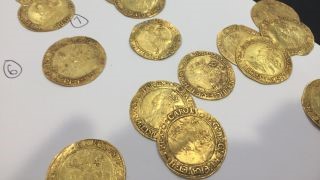
【《We Chinese in America》Media Editor Tang Zhao, September 20, 2022】Homeowners in the United Kingdom discovered a stash of gold coins hidden beneath the wood floorboards of their kitchen during a renovation. The hoard includes gold coins from England dating back to the 17th and 18th centuries. (Image credit: Courtesy Spink & Son)
The cache, which is estimated to be valued at around $290,000 (250,000 pounds) at auction, is believed to be one of the largest hoards of 17th- and 18th-century English gold coins ever found in Britain and includes more than 260 gold coins dating to between 1610 and 1727, according to CNN(opens in new tab).
The discovery occurred in 2019, when contractors unearthed a salt-glazed earthenware cup, similar in size to a soda can, as they pried up the floorboards during the renovation project at the 18th-century home, located in Ellerby, a village in North Yorkshire.
Upon further inspection, the workers found some of the coins rattling inside the cup, which consisted mainly of 50- and 100-pound coins "that were used at the time," as well as a Brazilian coin that circulated in England during the 1720s, according to a statement from Spink & Son, a London-based auction house.
"It is a wonderful and truly unexpected discovery from so unassuming a find location," Gregory Edmund, an auctioneer with Spink & Son, told CNN.
The coins likely belonged to Joseph and Sarah Fernley-Maisters, members of an influential mercantile family that included several members of Parliament who lived in the area during the late 1600s and early 1700s, according to the statement.
"Joseph and Sarah clearly distrusted the newly formed Bank of England, the 'banknote' and even the gold coinage of their day because they [chose] to hold onto so many coins dating to the English Civil War and beforehand," Edmund said in the statement. "Why they never recovered the coins when they were really easy to find just beneath original 18th-century floorboards is an even bigger mystery, but it is one hell of a piggy bank."
Next month, the treasure trove will go up for auction through Spink & Son and is expected to fetch nearly $300,000.
(Source: Life Science)
This website has a free subscription function, please enter your email address and name (any nickname) in the upper right corner of the page. After subscribing, you can receive timely updates of the website. I hope that new and old readers will actively subscribe, so that we have the opportunity to provide you with better services
Please click: Home (wechineseus.com) for more news and content on this website
Follow The Chinese Media's Twitter account: https://twitter.com/wechineseinus
Follow The Chinese Media's Facebook account: https://www.facebook.com/wechineseinamerica/